Showing posts with label Beijing. Show all posts

Sunday, October 17, 2010

Beijing, Day 1

Well, we're here, but getting here was not easy. We took a soft sleeper from Shanghai. There were two other people in our car, but they kept to themselves. It wasn't until the man asked Bobby if he could turn off the light that we realized that he spoke excellent English. One thing I like about Chinese (and Japanese) people is their standoffishness. If he were Korean and spoke English, he would not be comfortable with silence.

We arrived at the station at about 8am. We walked around awhile looking for a taxi line, and when we finally found one there was a long line. Several men approached us and offered us a taxi, but I know by now that an unlicensed taxi is a bad idea. Our taxi driver made a genuine effort to get us to our hotel, but there was just too much traffic. He tried two different approaches to our street, but both were at a standstill. Finally, Bobby asked him to let us out and point us in the right direction.

We wandered around for awhile, suitcases in tow, until we found a Hilton. The bellhop there was very solicitous and got us a map. We then ran into our first “art student”. We would meet several more. He spoke excellent English and told us he was preparing to study in the U.S., as, we would discover, was a commons story. He did help us find our hotel, but (in all honesty) it was after we bought a painting from him. It's a beautiful calligraphy, but we probably paid too much—a cardinal sin to the Lonely Planet guide. This art student scam is a long con. They talk to you for awhile, asking questions and behaving like they are studying English. I'm used to Koreans doing this, but the “art students” do eventually ask for money. My dad once said he would offer bums money if they didn't give him the story. I feel the same way about the “students.” In Shanghai, there are tons of people walking around trying to sell watches, but they are straightforward about what they want, as are the unlicensed taxis. Something about the students con rubs me the wrong way (and I love my painting and we were planning to buy one anyways), and by the time I met my fourth student I was telling them to piss off. Anyways, we got to our hotel and the clerk told us the hotel had no power and that he would take us to another hotel. It was a bummer, because the hotel I chose overlooks the forbidden city. He will bring us back in two days, but in the meantime we have a five star Chinese hotel that's close to the shopping district.

When we finally got into our room, it was almost noon and Bobby had no suitcase. The staff had delivered his suitcase to the wrong room. The problem was eventually corrected, but we were not in the mood to deal with it.

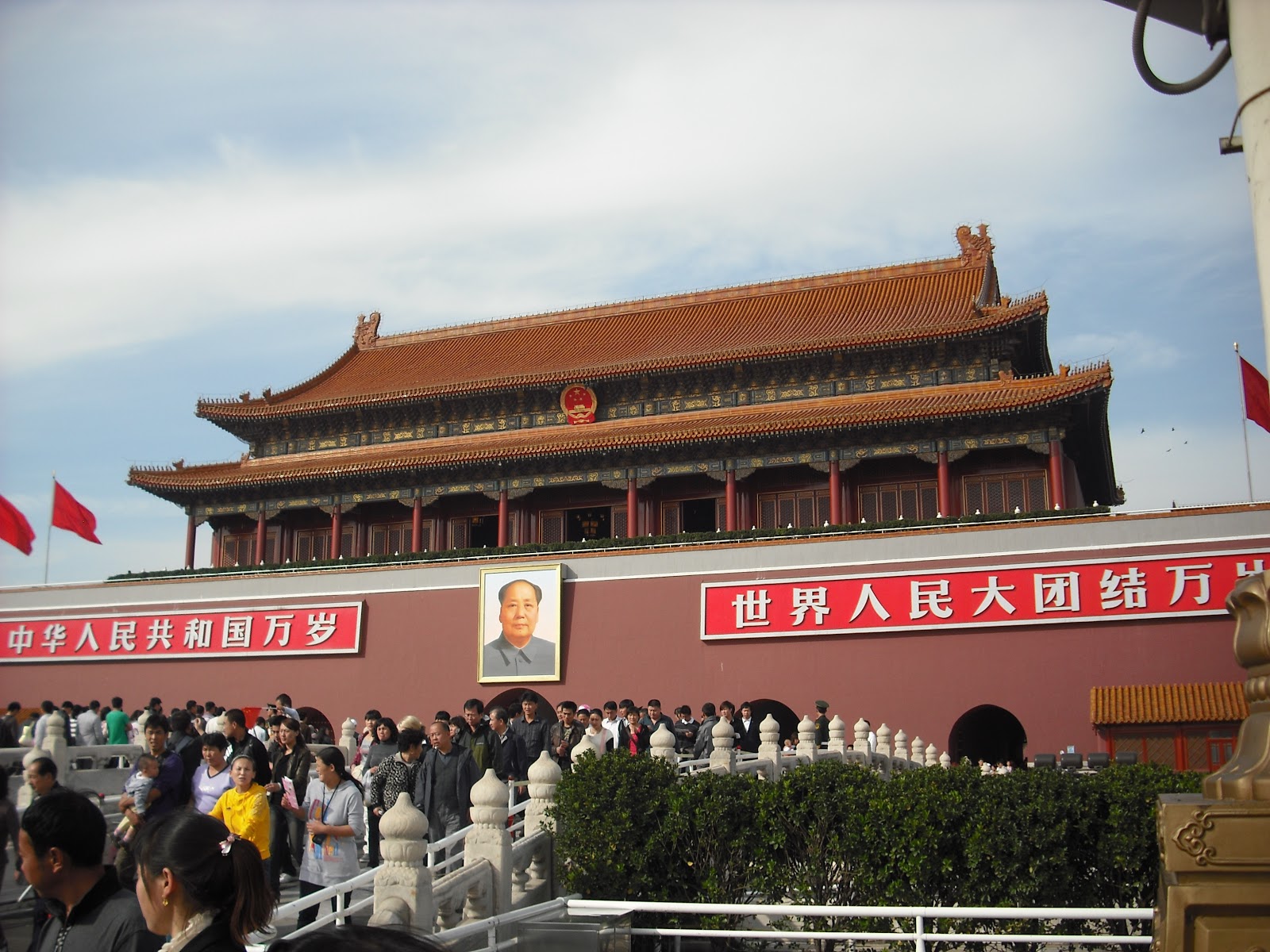
We had lunch and set out for Tiananmen Square. It was incredibly imposing. For one thing, it's massive. There are lots of soldiers and metal detectors at each entrance. In the center of the square, there are two giant screens that show propaganda: waving flags, patriotic songs, etc. The buildings surrounding the square are ominous and imposing. To top it all off, every few feet there are light poles with three or four cameras on them pointing in all directions. I was creeped out, and we didn't stay long. Most countries will admit the bloody parts of their history, but China has glossed over the Tiananmen Square massacre and the Cultural Revolution. Officially, Mao is still a hero.

One of the things Bobby and I do best is wander around and find interesting things. Today we found a historic “rice road” that used to be the main thoroughfare for bringing goods into the palace off the left side of the square. It was lined by some old looking walls, and there were some doors in the walls with stores behind them that have probably been there for centuries. We saw a colonial European looking church and some old mansions, where (I imagine) nobles used to live. It was also refreshingly free of tourists and the people who prey on them. We returned down a huge shopping street and saw a 7 story book store.

For dinner, we visited Xiao Wang's Home Restaurant in Ritan Park, a very popular place that was listed in our guidebook. We had Peking duck and a couple other dishes, and we were not disappointed. The restaurant was worth the hype. I have been reading about Chinese haute cuisine, so when I order dishes I can't help but feel we are doing it wrong, but our duck, dumplings, and soup were delicious. We walked around the park afterwards and ran into several dance classes. I have seen dance classes in Central Park. They do it in Beijing, too! We also walked down Embassy Row, though there were no indicators on any Embassy so we couldn't tell which one was ours. We saw another shopping mall with a huge LED billboard for a roof. It lit up the entire street. Beijing has a lot of character. There are ostentatious futuristic buildings right around the corner from buildings which could be 500 years old. For all it's brutishness, I like it a lot.
A street corner

Recognize this?

Giant propaganda screen

Cameras, Cameras

Statues in the square

The Rice Road

Seven story bookstore

The Great Wall at Mutianyu

Today we went to the Great Wall at Mutianyu. This section of the wall is about 70km outside of Beijing, so we had to sign up for a tour at the tour desk in our hotel. We piled into a bus with 8 other English speakers, only one of whom was American. We have noticed that Americans are in the minority of Western tourists here. There are far more Europeans. The other people on the bus were German and Austrian.

We drove out of the city and into a sprawling countryside filled with courtyard houses, wide roads, and empty space. We headed for some mountains, while our tour guide told us some interesting things about Beijing. There are 1,900 new cars in Beijing every day. To deal with the pollution and traffic congestion, both of which are substantial, people with license plates with certain numbers are not allowed to drive on designated days. Every day, 1/5 of the cars in Beijing are not allowed to drive. She also told us about family planning, which we call the one child policy. It's a little more complex than that, apparently. People in an ethnic minority (not Han Chinese) get to have as many children as they want. Two people who are only children can have 2 children.

We got to the wall, and headed down a gauntlet of shops with increasingly familiar hawkers. We took a cable car up to the top of the mountain, and below us I could see some old walls, I guess meant to keep the path from flooding. We discovered that the wall is basically a giant staircase. Some of the stairs were perilously high and small, but we slogged until we got to the end of the reconditioned wall. There were gatehouses at regular intervals that were pretty big: each had about six or seven rooms. This must have been where people lived. Our guide told us that there were farms all around the wall so the soldiers could feed themselves. There were vendors at regular intervals selling overpriced water, which we bought. Going down the mountain was delightful: we each took a toboggan down a loopy track. It was like a carnival ride.

On the way back we were pushed into a state supported “healing center” where we were offered free foot massage (no one took it) and a palm reading. We were all analyzed by a Chinese doctor and advised to buy expensive traditional medicine. One thing I will say is the guy felt my pulse, looked at my tongue, and pinched my ear, and he was dead on about me. I do have poor circulation and pains in my stomach. I went through a lot of testing a couple of years ago to discover that there's nothing really wrong with me, and the Chinese doctor apparently could have told me what caused it in 10 seconds. I did not buy the medicine.

When we got back, we were hungry, so we hit the Donghuamen Night Market. This is a row of food stalls that sets up in the late afternoon. It was similar to the food stalls in Korea, but with a much wider variety. We had fried banana balls, eel sticks, corn cakes, and some jello like substance. We went out for dinner a few hours later. We headed for a restaurant recommended by Nicole Mones, who wrote The Last Chinese Chef. We actually did not find the place. There was no English on the sign and the address was not readily evident. We went inside a restaurant with a nice English hawker, who helped us select the best meal we have had in China. It was incredible and less than $20. When we got outside, we found the restaurant we were supposed to go to, but it was a happy mistake.

We walked to the bell and drum tower, which are massive structures built by the emperor to tell the time. They were impressive, even at night. We wandered the hutongs for awhile. Hutongs are old streets designed by the Mongols. They are really thin and accessible only by bicycle and small car. These were lined with old structures and very picturesque. I wish I could have gotten a picture, but my camera doesn't do night shots.
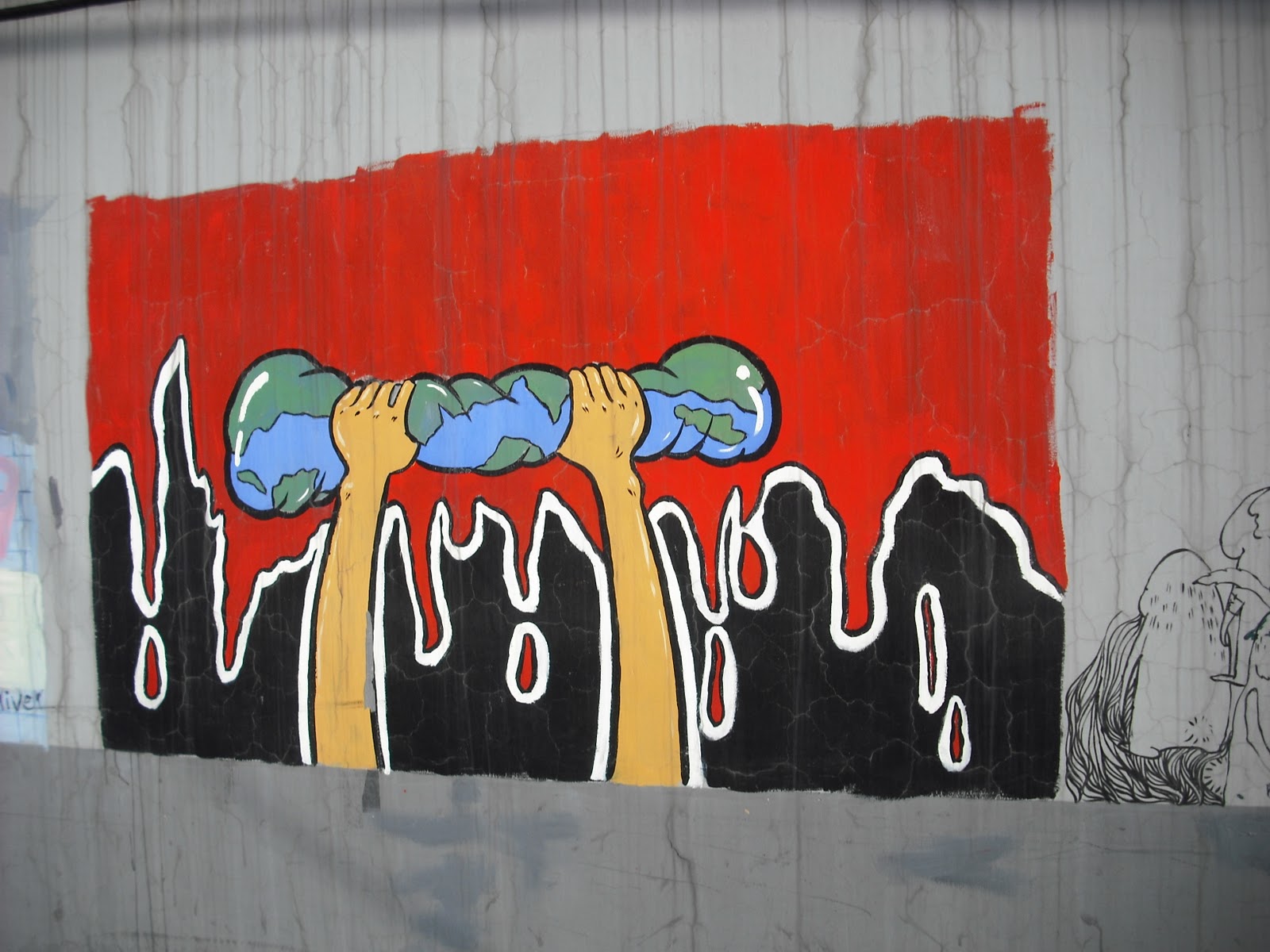
This was painted on a wall in a hutong behind our hotel

Cable cars to the wall

An ancient view.  Watch out for Mongolians!

Bobby shakes his fist at Mongolians

The wall

A particularly treacherous set of stairs

Here we are!

Night market

Detailing on one of the guardhouse roofs

The Forbidden City

We devoted today to the Forbidden City, which is right around the corner from our hotel. Well, the East Gate to the city is right around the corner from our hotel. Getting to the front entrance is actually a bit of a slog. This is because the Forbidden City is massive. Only part of it is open to the public, and it took us 6 hours to see that part.

I know a little about China's emperors and the city, a subject I have long been fascinated with. Most Chinese people never saw it, hence the name. The front half is where important people got to enter—ministers, foreign dignitaries, people taking the state examination. The back half is where only the emperor, his family, the servants, and the hundreds of concubines and eunuchs got to go. The eunuchs ran the place. They were tutors, performers, cooks, stewards, etc. The entire city is set up more or less symmetrically, with the important buildings on the central axis and smaller palaces on the east and west sides. This perfect symmetry made visiting all the buildings kind of boring, though the curators spiced it up a bit by putting different exhibits in the different palaces.

We came in through the North Gate, which was the private end of the city. North is the direction for important people. We walked through some peaceful gardens, pavilions, and a tower. At the center was a hall of peace, where the emperor went to pray. At one side was the two story building where an English tutor gave the last emperor, Pu Yi, lessons in English (that's in a movie called The Last Emperor). To be honest, given the crush of people it was hard to imagine it. When we ducked into the side courtyards, we got away from some of the crush. The living quarters of the emperor and empress were more or less preserved behind glass, and we could peer in. There were a couple of houses for imperial concubines that we saw, though there were many more in areas we could not access. The emperor had hundreds of concubines, all of whom were ranked. Concubines had the joy of waiting around all day and night to be summoned. They spent a lot of time dressing themselves, playing games, writing, and (I'm guessing) playing in the cutthroat politics of women who were competing against each other. It must have been a horrid life, and the whole time these women's families on the outside (whom most never saw again) wrote to them about how privileged they were, to quit whining because their neighbors starved to death last winter. I wonder how many of them committed suicide.

In some of the halls were displays of imperial dishware, jade, and pictures. We saw Pu Yi's telephone, the first and only imperial telephone. We saw the concubines dishes, painted according to ranking. We meandered down to the center area. I wanted to come up through the southern route, so we walked around the outside to the south side if the city. When we passed the meridian, the buildings became distinctly more awe inspiring. We saw some displays of weaponry, armor, and imperial gifts in little galleries along the side. When we got to the south gate, we saw a massive and imposing structure. There was an artificial stream in front in the shape of the emperor's bow. We walked through a couple of gates to the hall of supreme harmony, which is the impressive hall where the Emperor made pronouncements and met dignitaries. Behind it is a preparation hall where he got ready to see the outside world, and behind that is a banquet and entertainment hall. They were ornate and majestic, but it was so crowded that it was hard for me to picture the emperor there. We had some dumplings right next to the hall of supreme harmony. We walked through the center gate, which most people passed through only once. Even princes were not allowed into the Emperor, Empress, and concubines' living area. After this, we were pretty tired and the park was closing, so we headed back out to Tiananmen Square. We discovered that behind the massive gate we saw earlier, there are two more gates. It's hard to imagine breaching it.

Visiting the Forbidden City was exhausting, and after a very forgettable dinner we called it a night.

A pagoda in the gardens
Our private courtyard in our hotel

The exterior wall and moat

The North Gate

A tower in the gardens

The hall where Pu Yi was tutored in English

Not sure, but it looks cool

The Hall of Supreme Harmony

An imperial lion

Not sure, but it looks cool

Huge doors

The South Gate

The Temple of Heaven and Behai Park

Today we wanted to go to the Temple of Heaven and the Summer Palace, two more “can't miss” sights of Beijing. I think that four days is an impossibly short time to stay here, because as you can see, we didn't make it to the summer palace. I see tour groups powering through the sites; they can see the Summer Palace, the Temple of Heaven, and the Forbidden City in one day, but they miss all the little side buildings, which are less crowded and a pleasure to visit. We didn't see everything, but I'm glad we took the time to peruse the sites we did visit.

Anyways, we went to the Temple of Heaven in the morning. It's about 5km away, so we took a cab. Beijing has terrible traffic. It took us about 20 minutes to get there. We entered through the South gate and saw the main ceremonial pavilion, which included a giant green oven where they burned shaved calves for ceremonies. All the big structures were on the central axis, just like in the Forbidden City. We walked down this axis from the pavilion to the Imperial Vault of Heaven, where we saw imperial ancestral tablets. The Emperor would walk from this shrine up this ceremonial path to the main temple, where he would perform the ceremony. We decided to let the crowds follow the Emperor, while we ducked out and headed left, towards the Palace of Abstinence. We were not sorry! There was an additional 20 rmb entrance fee (about 3 dollars) for the two of us, and apparently that kept almost everyone out. It was almost our private palace! This is where the Emperor used to fast in preparation for the ceremony. There was a “pillarless hall” that contained portraits of the later emperors and these huge structures that held the tablets. We saw a bell tower which would ring when the emperor entered and left the fasting palace.

We returned to the main axis, where we saw the awe inspiring Hall of Prayer for Good Harvests, which was where the Emperor performed this ceremony to heaven. We saw an exhibit on the ceremony, which spelled out the intricate and precise progression of events required to appease the gods. We followed a covered walkway to the kitchen and butchery, where the calf was prepared for the slaughter. At this point, Bobby discovered that we had missed the music hall, which was all the way across the park. Fortified with cream filled saltines (they're actually pretty good), we headed back across the park, which was about 1.5km. It was worth the walk. The music hall was incredible and also not crowded. There were displays of several traditional Chinese instruments, all of which had a large model in the center that we could try. There were also pictures of the ceremonies and dance costumes. The entire compound, which resembles a palace, housed the musicians and dancers who spent their days rehearsing for the ceremony.

We grabbed another cab back to our hotel (cabs are like $2 here), where we ascertained that a trip to the summer palace was unfeasible. Instead, we grabbed some dumplings at a wonderful shop around the corner, where (according to the sign on the wall) the owner's family used to make dumplings for the Emperor. On the way back, we checked out some ruins that turned out to be from the East Wall of Imperial Beijing.

We decided to visit Behai and Jinshan park instead. Behai Park is where Kubla Khan set up his palace. It has a huge lake with an island in the middle made from the earth excavated for the lake. The island had a Temple of Jade Flowers and, further up, a white dagoba that was built for a Dalai Lama's visit. We had a nice view from the temple, but I wanted to see the view from Jinshan park before it got dark. We cut our visit short and walked back across the lily filled lake and out of the gate. Jinshan park was a leisure ground for the imperial family. It has a huge hill in the middle created from the earth excavated from the palace moat, with a couple of pagodas on top. We saw the spot where an emperor hung himself (there was a peasant rebellion, he killed his wife and some of his concubines and sisters, travelled to Jinshan park with a eunuch, and wrote his suicide note in blood before he hung himself). We hoofed it to the top for an unparalleled view of the Forbidden City right at dusk. On the other side of the hill, I could see the old North Gate. The old South Gate is at the bottom of Tiananmen Square. The square is all lit up at night, and we saw some of it from the hill.

We walked back to our hotel, where we had ½ hour before we left for dinner. We had made reservations at a place called Huang Ting, a fancy Cantonese restaurant that was highly recommended. The interior was constructed entirely from bricks from old hutongs. The food was incredible—we had one last taste of Peking Duck and the chef's specialty, crab over asparagus.

I was sorry to leave, but I imagine we'll visit China again in our lifetime. I hope so.

The ceremonial oven where they burned calves

Many imperial structures had three entrances.  Only the Emperor could go in the middle door.

The Imperial Vault of Heaven

People dancing in the park

The Hall of Abstinence.  The vats are filled with water in case of fires.

The bell tower.  They rang this bell when the Emperor entered and left the hall.

The Hall of Prayer for Good Harvests.  

The Hall of Music.  The screen on the right side is to keep evil spirits out.


The ceremonial pavilion.
The White Dagoba in Behai Park
The Forbidden City at Dusk