Showing posts with label China trip. Show all posts

Sunday, October 17, 2010

China: The Good, the Bad, and Everything in Between

I have written a good deal about our trip, but I think it warrants an overview, particularly for those less interested in reading pages of my musings. China: I have been reading books and watching movies about it for years. Our whirlwind tour was surely not enough to give me a comprehensive view of such a large country, but I do leave with some distinct impressions.

First of all, if you have ever been to a big Chinatown, say in New York or Los Angeles, you are already familiar with China. The main tourist areas are full of the same food markets, endless stores full of trinkets, and that distinct fishy smell. China is also similar to Korea with its back alleys full of activity, laundry hanging from windows, bicycle commuters, people wearing face masks, exercise equipment everywhere, and old men playing games on the sidewalk. One new thing was the masses of people dancing in the parks. The first time I saw this, I was thrilled and had to stand and watch through a couple of songs. We saw it again and again throughout our stay. Sometimes there were different dance groups with competing music right next to each other.

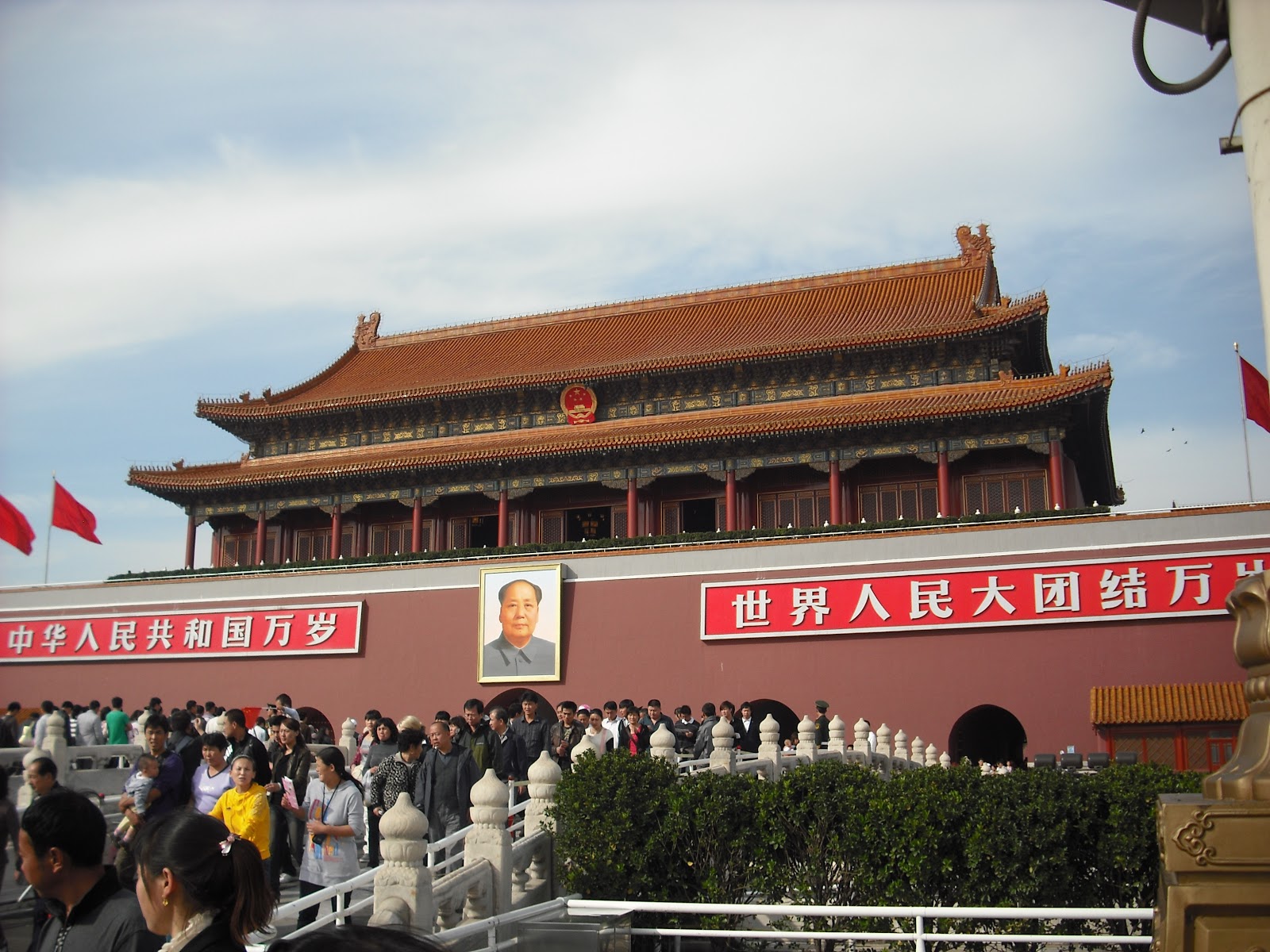
The Chinese diaspora is brutally honest about China's past, particularly the crimes of Chairman Mao, so I was kind of surprised to see his picture on all of the money. There is a Mao museum and a large portrait in Tiananmen Square. Many slogans from the cultural revolution have been quietly painted over, but China has not admitted to its ugly past. The presence and absolute power of the Chinese government was intimidatingly evident everywhere. Many major sites had bag scanners. Bobby and I were wanded each time we went to the airport, and there were cameras everywhere. No wonder there hasn't been a terrorist attack in China.

The Chinese people do not have any of the consideration of Korean and Japanese people. They shove each other aside to get on the subway, cut in line, and are constantly trying to bilk tourists out of their money. Both Shanghai and Beijing have distinct big city attitudes, unlike Seoul. Bobby and I were surprised at how many street people spoke excellent English. They would often try to engage us in conversation to try and sell us something. At first, we were happy to talk to them, but after the second day we would just ignore shouts of “Hello! Where are you from?” The Chinese don't have the earnest friendliness of the Koreans. It's like comparing North Carolina with New York. This can be refreshing, as I don't ever know how to end a polite conversation with a Korean, and sometimes their solicitousness can be downright rude (a woman once grabbed money out of my hand to try and show me how to charge my subway card, something I know well how to do.)

China's cities are as diverse in nature as the country, which was a refreshing change. There are people from all over the world. The architecture itself varies from traditional imperial to communist utilitarian to colonial European. We saw mosques and kebab houses, which are not evident anywhere in Korea.

The traffic is a nightmare, and it's not easy to get around. Cars don't move on the roads, and the subways fit an unbelievable amount of people. We walked for miles and miles to see everything, which is really the best way to see a city anyway. We stumbled across some interesting things that were not in guidebooks. The air is very dirty, visibly so.

The food is out of this world. Meals are always shared, like in Korea, but there are far more flavors and textures. Every time we went out we ordered three or four dishes, and we never had a meal we were not happy with.

We had a wonderful time, and were both sorry we could not stay longer. China has much more to offer than can be experienced in a week. I have taken far more pictures than will fit in this blog. You can find the rest here.
China

The Bund


We spent a lot of time in transit to get here. First we took the KTX to Seoul, then the shuttle to Incheon airport, then a flight to Shanghai, a maglev from the airport to the city, and a cab to our hotel. The maglev is worth mentioning. It goes 440 km per hour and banks to turn, and I found it a slightly terrifying experience. Bobby thought it was cool.

When we finally got here, we headed for The Bund, which is a picturesque and crowded, area by the river. One side of the river is lined with old European buildings, and the other sports flashy, space age buildings. It was well worth the crowds. There is a lot of history on the Bund, which was where the British set up shop after the Opium Wars. The venerable buildings included a British consulate built in the mid 1800's, an old customs house, and a fusty old club where “Chinese and dogs” were not allowed. It's a wonder that the Chinese let these symbols of British imperialism stand, but they are beautiful now (and all fly Chinese flags). There is a steady flow of barges heading through the canal. It is almost like watching cars on the highway. On the other side of the river, after nightfall, there are twinkling buildings, buildings with candy colors, and two with video shows on their sides. We had a drink at an old signal house, where we sat on the roof and watched the city light up (well worth the overpriced drinks).

We then squeezed into the ferry with tons of Chinese and headed to the other side of the river. The light show intensified: all of the trees lining the boulevard had green or blue lights on them, and some had white “icicles” hanging from them. It sounds garish, but it was tastefully done, probably for the Expo. We went to the observation deck of the World Financial Center, which is the highest observation deck in the world (or was, they weren't very clear). It was 492meters up, and there was a section in the middle with a glass floor so you can see just how high up you are. Bobby loves these things, and we go to one at every city we visit.

On the third floor, we found a dumpling restaurant. This is exactly what I wanted. I have been reading The Last Chinese Chef, and I was very eager to eat some dumplings. They did not disappoint, though I popped a couple in my mouth before they were adequately cool.

Western influence is very obvious in Shanghai. Aside from the buildings, there are Mc Donalds's, Krispy Kremes, KFC's, and Starbucks, everywhere. We even saw a Hardee's and a Best Buy. We have not yet seen a temple or anything resembling one, but we are in the industrialized area of town. Shanghai has long been a commercial center, and there is not much evidence of old China here.
The Bund

It looks like a space needle

I think this is a customs house


You can kind of see the light display


Yuyuan Gardens and the French Concession


We were going to visit the Expo today, but Bobby pointed out that it's Sunday and there will be less people there tomorrow. We will never be able to avoid crowds; not in Shanghai at this moment. I don't know if it is always this crowded or if people have poured in for the Expo. The event is evident all over Shanghai. There are signs, statues, and topiaries that say Expo 2009, and there are police everywhere. There are bag scanners in the subway, and wherever we go, tons and tons of people.

Anyways, Expo tomorrow. We decided to go to Yuyuan Gardens, which is lovely in the pictures and right in the middle of Old Town. We got there to find a huge crunch of people. “Old Town” doesn't look particularly old, though the traditional architecture is beautiful. It's a cluster of stores that was jam packed with tourists. We found our way to the gardens and paid the entrance fee, which got us away from the overwhelming crunch. The gardens were lovely. There were clusters of pathways, lots of pagodas, pools with koi, and grottoes. The whole thing used to belong to the obviously well heeled Yu family back in the 16th century. We laughed about what old Yu is thinking now, with his estate packed with gawking commoners and foreigners. Even with all the people, it was peaceful.

We wandered back through the crowds into a temple. It looked like a Korean buddhist temple, but there were no Buddhas. Instead, there were several different structures honoring different gods. China has many gods, most of whom were real people at some point. I was excited to find the temple to the god of literature. There were a lot of people praying, and each of the gods had offerings of dumplings and fruit. Bobby pointed out that at one shrine depicting three gods and a tiger, someone laid out a dumpling for the tiger. There was one temple with three different gods of wealth, and another shrine had a god of war and wealth. It was no surprise that Shanghai, with it's relentless commercialism, has four different gods of wealth in it's town temple. In retrospect, I realize that several of these gods are in Buddhist temples in Korea, though Buddha gets the main slot. Buddhists, I remember, are allowed to worship other gods.

We pushed our way into a three story dumpling shop (“dumplings again? Says Bobby”) but there was absolutely no space. We wandered a bit until a woman lured us into her restaurant, which had dim sum but “expensive” enough so that we didn't have to deal with crowds (our meal was less than $30). We had fabulous dim sum with Chinese businessmen and European tourists.

We noticed some cats outside of the gardens, and more around the city. One was sleeping in the rafters of a temple. Shanghai is a cat city. I bought this kitschy porcelain cat, the kind of tourist fare I normally avoid but I love cats! I have been living in an anti-cat country and was thrilled to see Shanghai's appreciation of their cats. The strays all look very clean and well fed.

We went out again for dinner, but this time to the French Concession. This was a true old town, full of colonial French buildings. One of these was the site of the first meeting of the Chinese Communist Party in 1921, a holy place for Chinese Communists. We found a bunch of restaurants, one of which was German. I told Bobby he could pick where we ate dinner since we had dumplings AGAIN, so this was serendipity for him. We ate on the sidewalk and watched all the tourists trundle by. We noticed a Haagen Dasz, which prompted me to wonder if there's a Haagen Dasz at every tourist spot in the world. I never see them in town, but you go to, say, the Old Church in Amsterdam and there's the Haagen Dasz. We walked among the buildings, which are stunning. I'm glad Shanghai kept them.
Old Town McDonalds

A sea of people

a teahouse

a design on the eaves

one of Yu's halls

grottoes

Shanghai god

Prayer ribbons ??

A magnificent stage

Kitty in the temple

Shanghai Expo ad.  That's the mascot
French concession


Shanghai Expo

Meh. I planned this entire trip around the Expo. I read Devil in the White city a few years ago, and it filled my head with dreams of a World's Fair with dizzying displays of tomorrow's technology. We probably should have visited a technology pavilion. Instead, what we encountered were long lines, pushy people, and bad food. There were some interesting pavilions. My favorite was probably The Netherlands, which was a multilevel display of Holland art, old and new. The bottom level was astroturf and model sheep. Canada had a display on sustainability where you could ride a bike and make a trippy cartoon run, complete with psychedelic music. They also managed to grow grass all over the side of their pavilion. Australia had a rotating set of screens that came out of the floor and retreated into the floor, revealing a new sculpture each time. Indonesia had an indoor waterfall. We waited in line the longest to see the USA pavilion, and it was so lousy we didn't even see the whole thing. It was almost entirely in Mandarin, and while every other pavilion displayed some of the country's contributions to art, history, and/or science, the US was a series of videos. The first showed a bunch of people in New York trying to say “welcome” in Mandarin and Kobe Bryant. I was annoyed. Were we trying to say we have no culture? Also, all the other pavilions had some English, but the US didn't? “Hi, we're America! Most of us look ludicrous trying to speak Mandarin, but we do have Kobe Bryant.” Guh.

It was also one of those places that brought out the worst in people. They shoved in line, like pushing me up against the person in front of me would get them in faster.

The entire event was massive, and there were 3 hour lines for some of the pavilions. The UK had a really long line and a neat looking pavilion. It resembled a giant pincushin.

So, World's Fair—I've seen one, I don't really need to see any more.
You see the sign!  No noising!

USA! USA!  What a bummer.

Some of the more creative buildings in Africa

This is inside the big Africa building

The UK pincoushin

The Netherlands

Part of the Czech Republic exhibit

Australia exhibit

Thailand

Beijing, Day 1

Well, we're here, but getting here was not easy. We took a soft sleeper from Shanghai. There were two other people in our car, but they kept to themselves. It wasn't until the man asked Bobby if he could turn off the light that we realized that he spoke excellent English. One thing I like about Chinese (and Japanese) people is their standoffishness. If he were Korean and spoke English, he would not be comfortable with silence.

We arrived at the station at about 8am. We walked around awhile looking for a taxi line, and when we finally found one there was a long line. Several men approached us and offered us a taxi, but I know by now that an unlicensed taxi is a bad idea. Our taxi driver made a genuine effort to get us to our hotel, but there was just too much traffic. He tried two different approaches to our street, but both were at a standstill. Finally, Bobby asked him to let us out and point us in the right direction.

We wandered around for awhile, suitcases in tow, until we found a Hilton. The bellhop there was very solicitous and got us a map. We then ran into our first “art student”. We would meet several more. He spoke excellent English and told us he was preparing to study in the U.S., as, we would discover, was a commons story. He did help us find our hotel, but (in all honesty) it was after we bought a painting from him. It's a beautiful calligraphy, but we probably paid too much—a cardinal sin to the Lonely Planet guide. This art student scam is a long con. They talk to you for awhile, asking questions and behaving like they are studying English. I'm used to Koreans doing this, but the “art students” do eventually ask for money. My dad once said he would offer bums money if they didn't give him the story. I feel the same way about the “students.” In Shanghai, there are tons of people walking around trying to sell watches, but they are straightforward about what they want, as are the unlicensed taxis. Something about the students con rubs me the wrong way (and I love my painting and we were planning to buy one anyways), and by the time I met my fourth student I was telling them to piss off. Anyways, we got to our hotel and the clerk told us the hotel had no power and that he would take us to another hotel. It was a bummer, because the hotel I chose overlooks the forbidden city. He will bring us back in two days, but in the meantime we have a five star Chinese hotel that's close to the shopping district.

When we finally got into our room, it was almost noon and Bobby had no suitcase. The staff had delivered his suitcase to the wrong room. The problem was eventually corrected, but we were not in the mood to deal with it.

We had lunch and set out for Tiananmen Square. It was incredibly imposing. For one thing, it's massive. There are lots of soldiers and metal detectors at each entrance. In the center of the square, there are two giant screens that show propaganda: waving flags, patriotic songs, etc. The buildings surrounding the square are ominous and imposing. To top it all off, every few feet there are light poles with three or four cameras on them pointing in all directions. I was creeped out, and we didn't stay long. Most countries will admit the bloody parts of their history, but China has glossed over the Tiananmen Square massacre and the Cultural Revolution. Officially, Mao is still a hero.

One of the things Bobby and I do best is wander around and find interesting things. Today we found a historic “rice road” that used to be the main thoroughfare for bringing goods into the palace off the left side of the square. It was lined by some old looking walls, and there were some doors in the walls with stores behind them that have probably been there for centuries. We saw a colonial European looking church and some old mansions, where (I imagine) nobles used to live. It was also refreshingly free of tourists and the people who prey on them. We returned down a huge shopping street and saw a 7 story book store.

For dinner, we visited Xiao Wang's Home Restaurant in Ritan Park, a very popular place that was listed in our guidebook. We had Peking duck and a couple other dishes, and we were not disappointed. The restaurant was worth the hype. I have been reading about Chinese haute cuisine, so when I order dishes I can't help but feel we are doing it wrong, but our duck, dumplings, and soup were delicious. We walked around the park afterwards and ran into several dance classes. I have seen dance classes in Central Park. They do it in Beijing, too! We also walked down Embassy Row, though there were no indicators on any Embassy so we couldn't tell which one was ours. We saw another shopping mall with a huge LED billboard for a roof. It lit up the entire street. Beijing has a lot of character. There are ostentatious futuristic buildings right around the corner from buildings which could be 500 years old. For all it's brutishness, I like it a lot.
A street corner

Recognize this?

Giant propaganda screen

Cameras, Cameras

Statues in the square

The Rice Road

Seven story bookstore

The Forbidden City

We devoted today to the Forbidden City, which is right around the corner from our hotel. Well, the East Gate to the city is right around the corner from our hotel. Getting to the front entrance is actually a bit of a slog. This is because the Forbidden City is massive. Only part of it is open to the public, and it took us 6 hours to see that part.

I know a little about China's emperors and the city, a subject I have long been fascinated with. Most Chinese people never saw it, hence the name. The front half is where important people got to enter—ministers, foreign dignitaries, people taking the state examination. The back half is where only the emperor, his family, the servants, and the hundreds of concubines and eunuchs got to go. The eunuchs ran the place. They were tutors, performers, cooks, stewards, etc. The entire city is set up more or less symmetrically, with the important buildings on the central axis and smaller palaces on the east and west sides. This perfect symmetry made visiting all the buildings kind of boring, though the curators spiced it up a bit by putting different exhibits in the different palaces.

We came in through the North Gate, which was the private end of the city. North is the direction for important people. We walked through some peaceful gardens, pavilions, and a tower. At the center was a hall of peace, where the emperor went to pray. At one side was the two story building where an English tutor gave the last emperor, Pu Yi, lessons in English (that's in a movie called The Last Emperor). To be honest, given the crush of people it was hard to imagine it. When we ducked into the side courtyards, we got away from some of the crush. The living quarters of the emperor and empress were more or less preserved behind glass, and we could peer in. There were a couple of houses for imperial concubines that we saw, though there were many more in areas we could not access. The emperor had hundreds of concubines, all of whom were ranked. Concubines had the joy of waiting around all day and night to be summoned. They spent a lot of time dressing themselves, playing games, writing, and (I'm guessing) playing in the cutthroat politics of women who were competing against each other. It must have been a horrid life, and the whole time these women's families on the outside (whom most never saw again) wrote to them about how privileged they were, to quit whining because their neighbors starved to death last winter. I wonder how many of them committed suicide.

In some of the halls were displays of imperial dishware, jade, and pictures. We saw Pu Yi's telephone, the first and only imperial telephone. We saw the concubines dishes, painted according to ranking. We meandered down to the center area. I wanted to come up through the southern route, so we walked around the outside to the south side if the city. When we passed the meridian, the buildings became distinctly more awe inspiring. We saw some displays of weaponry, armor, and imperial gifts in little galleries along the side. When we got to the south gate, we saw a massive and imposing structure. There was an artificial stream in front in the shape of the emperor's bow. We walked through a couple of gates to the hall of supreme harmony, which is the impressive hall where the Emperor made pronouncements and met dignitaries. Behind it is a preparation hall where he got ready to see the outside world, and behind that is a banquet and entertainment hall. They were ornate and majestic, but it was so crowded that it was hard for me to picture the emperor there. We had some dumplings right next to the hall of supreme harmony. We walked through the center gate, which most people passed through only once. Even princes were not allowed into the Emperor, Empress, and concubines' living area. After this, we were pretty tired and the park was closing, so we headed back out to Tiananmen Square. We discovered that behind the massive gate we saw earlier, there are two more gates. It's hard to imagine breaching it.

Visiting the Forbidden City was exhausting, and after a very forgettable dinner we called it a night.

A pagoda in the gardens
Our private courtyard in our hotel

The exterior wall and moat

The North Gate

A tower in the gardens

The hall where Pu Yi was tutored in English

Not sure, but it looks cool

The Hall of Supreme Harmony

An imperial lion

Not sure, but it looks cool

Huge doors

The South Gate

The Temple of Heaven and Behai Park

Today we wanted to go to the Temple of Heaven and the Summer Palace, two more “can't miss” sights of Beijing. I think that four days is an impossibly short time to stay here, because as you can see, we didn't make it to the summer palace. I see tour groups powering through the sites; they can see the Summer Palace, the Temple of Heaven, and the Forbidden City in one day, but they miss all the little side buildings, which are less crowded and a pleasure to visit. We didn't see everything, but I'm glad we took the time to peruse the sites we did visit.

Anyways, we went to the Temple of Heaven in the morning. It's about 5km away, so we took a cab. Beijing has terrible traffic. It took us about 20 minutes to get there. We entered through the South gate and saw the main ceremonial pavilion, which included a giant green oven where they burned shaved calves for ceremonies. All the big structures were on the central axis, just like in the Forbidden City. We walked down this axis from the pavilion to the Imperial Vault of Heaven, where we saw imperial ancestral tablets. The Emperor would walk from this shrine up this ceremonial path to the main temple, where he would perform the ceremony. We decided to let the crowds follow the Emperor, while we ducked out and headed left, towards the Palace of Abstinence. We were not sorry! There was an additional 20 rmb entrance fee (about 3 dollars) for the two of us, and apparently that kept almost everyone out. It was almost our private palace! This is where the Emperor used to fast in preparation for the ceremony. There was a “pillarless hall” that contained portraits of the later emperors and these huge structures that held the tablets. We saw a bell tower which would ring when the emperor entered and left the fasting palace.

We returned to the main axis, where we saw the awe inspiring Hall of Prayer for Good Harvests, which was where the Emperor performed this ceremony to heaven. We saw an exhibit on the ceremony, which spelled out the intricate and precise progression of events required to appease the gods. We followed a covered walkway to the kitchen and butchery, where the calf was prepared for the slaughter. At this point, Bobby discovered that we had missed the music hall, which was all the way across the park. Fortified with cream filled saltines (they're actually pretty good), we headed back across the park, which was about 1.5km. It was worth the walk. The music hall was incredible and also not crowded. There were displays of several traditional Chinese instruments, all of which had a large model in the center that we could try. There were also pictures of the ceremonies and dance costumes. The entire compound, which resembles a palace, housed the musicians and dancers who spent their days rehearsing for the ceremony.

We grabbed another cab back to our hotel (cabs are like $2 here), where we ascertained that a trip to the summer palace was unfeasible. Instead, we grabbed some dumplings at a wonderful shop around the corner, where (according to the sign on the wall) the owner's family used to make dumplings for the Emperor. On the way back, we checked out some ruins that turned out to be from the East Wall of Imperial Beijing.

We decided to visit Behai and Jinshan park instead. Behai Park is where Kubla Khan set up his palace. It has a huge lake with an island in the middle made from the earth excavated for the lake. The island had a Temple of Jade Flowers and, further up, a white dagoba that was built for a Dalai Lama's visit. We had a nice view from the temple, but I wanted to see the view from Jinshan park before it got dark. We cut our visit short and walked back across the lily filled lake and out of the gate. Jinshan park was a leisure ground for the imperial family. It has a huge hill in the middle created from the earth excavated from the palace moat, with a couple of pagodas on top. We saw the spot where an emperor hung himself (there was a peasant rebellion, he killed his wife and some of his concubines and sisters, travelled to Jinshan park with a eunuch, and wrote his suicide note in blood before he hung himself). We hoofed it to the top for an unparalleled view of the Forbidden City right at dusk. On the other side of the hill, I could see the old North Gate. The old South Gate is at the bottom of Tiananmen Square. The square is all lit up at night, and we saw some of it from the hill.

We walked back to our hotel, where we had ½ hour before we left for dinner. We had made reservations at a place called Huang Ting, a fancy Cantonese restaurant that was highly recommended. The interior was constructed entirely from bricks from old hutongs. The food was incredible—we had one last taste of Peking Duck and the chef's specialty, crab over asparagus.

I was sorry to leave, but I imagine we'll visit China again in our lifetime. I hope so.

The ceremonial oven where they burned calves

Many imperial structures had three entrances.  Only the Emperor could go in the middle door.

The Imperial Vault of Heaven

People dancing in the park

The Hall of Abstinence.  The vats are filled with water in case of fires.

The bell tower.  They rang this bell when the Emperor entered and left the hall.

The Hall of Prayer for Good Harvests.  

The Hall of Music.  The screen on the right side is to keep evil spirits out.


The ceremonial pavilion.
The White Dagoba in Behai Park
The Forbidden City at Dusk